CONTACT US
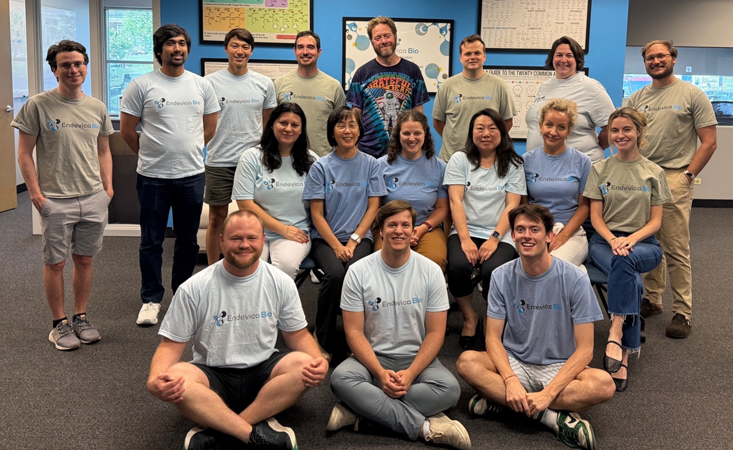
Endevica Bio staff, including Chief Executive Officer Russell Potterfield
Editor’s Note: Endevica Bio is a first-time PanCAN PurpleStride Sponsor, joining us at PurpleStride Chicago as Premier Sponsor. Guest author Dan Marks, MD, PhD, Co-Founder and Chief Medical & Scientific Officer of Endevica Bio, shares his personal ‘why’ and the dedication driving his company’s development of groundbreaking therapies to improve quality of life for patients with pancreatic cancer.
One of my treasured childhood photographs shows my kindergarten class, with about twenty small children sitting on the grass near a lake. I was an unruly kid with sun-bleached hair sitting in the front row. Next to me sat my best friend who shared my love for roaming the thousands of acres of game refuge where we both lived. We were close, far more like siblings than friends. As we approached high school graduation many years later, he started to feel sick all the time and began to lose weight. Ultimately, he was diagnosed with a deadly form of bone cancer that took his life after just six months. Without question, watching my friend waste away from his cancer, a condition I later learned is called cachexia (pronounced ka-kex-ee-a, from the Greek roots for “bad condition”), planted the seeds of determination that would define the rest of my career.
Unintentional weight loss is a hallmark of cachexia, which is common in several types of cancer and other chronic diseases. As many as 80% of people with pancreatic cancer will be diagnosed with cachexia, defined as losing more than 5% of their body weight. For many, involuntary weight loss is what prompts them to see a doctor in the first place, before they receive a pancreatic cancer diagnosis.
Those suffering from cachexia primarily lose muscle rather than fat, the opposite of what is seen with dieting and starvation. In addition, the weight loss is accompanied by a loss of appetite and cannot be cured by increasing nutrition. Certainly, improving nutrition and doing everything possible to maintain physical fitness will help prevent muscle loss and other problems associated with cachexia. However, there are no currently approved drugs that effectively prevent or treat cachexia in people with cancer.
But there is hope.
The centers in the brain that respond to systemic illness signals and produce the sickness response are now defined, and we can use that knowledge to design new treatments based on these fundamental discoveries in neuroscience. Furthermore, we can combine these discoveries with insights into how the brain regulates the function of other organs and design new drugs that will prevent or treat cachexia without causing significant side effects.

Endevica Bio staff, including Chief Scientific and Medical Officer Daniel Marks
We are proud to be a part of PanCAN PurpleStride Chicago as a first-time Premier Sponsor.
Although cachexia is common, many people still do not clearly understand what causes it or what can be done to manage it. In addition to developing a new therapy to treat cachexia, Endevica Bio strives to educate people about what is — and isn’t — driving people’s weight loss, what the brain’s got to do with it, and what new treatments are being tested in clinical trials, including our investigational therapy.
As a physician, I have seen the devastating impact of cachexia on patients and their families and felt their frustration at having no effective treatment. It has been nearly forty years since my friend died, and for much of that time, the options for people with cachexia have remained limited. The Endevica Bio team is optimistic for the future, when we have new, better tools to counter the effects of cachexia and can help lighten the load of people on their cancer journey.