CONTACT US

Julie Fleshman, JD, MBA President & CEO, PanCAN
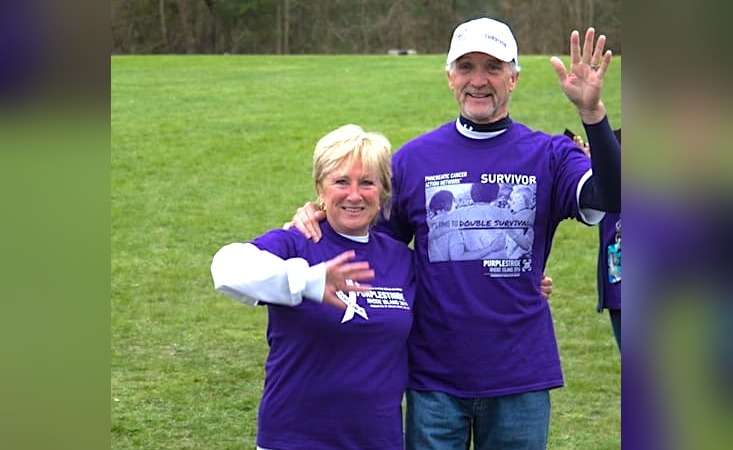
This past weekend, I had the incredible honor of attending PanCAN PurpleStride, joining thousands of people who came together to celebrate pancreatic cancer survivors, honor those we’ve lost, and raise critical funds to accelerate progress for patients. At PurpleStride, we also launched our most ambitious fundraising campaign yet — All Together We Can — a five-year, $250 million campaign to accelerate breakthrough research, expand our Patient Services program, and further strengthen the remarkable pancreatic field.
PanCAN has always led the way and our bold campaign is no different. It comes at an extraordinary time in pancreatic cancer research — we are on the threshold of a new era of treatments for patients thanks to years of investment in research and advocacy. PanCAN is determined to build on this moment.
When I began this work more than 26 years ago, there were few options and the outlook for patients was dismal. I witnessed my father dying from pancreatic cancer just four months after his diagnosis — he had been given no options and no hope. Standing alongside families at PurpleStride this past weekend, I was confident in saying that we’ve turned a corner. In just the past few weeks, there has been positive news about a KRAS targeted drug and promising mRNA vaccine approaches. The breakthroughs we have all worked so hard for are finally coming to fruition.
The data are compelling. A clinical trial testing a new oral therapy, daraxonrasib, targeting KRAS — long considered “undruggable” – has shown that patients with previously treated metastatic disease may live approximately twice as long as those receiving standard chemotherapy. Because of the frequency of KRAS mutations in pancreatic tumors, this result holds the potential to change how nearly every patient with pancreatic cancer will be treated in the future.
At the same time, emerging mRNA vaccines designed to train the immune system to recognize and attack lingering cancer cells after surgery are showing promising early results, strong enough to move into larger clinical trials.
These are not incremental steps. They represent a turning point. They mean more time and more options for patients — two things I desperately wanted for my dad – that now feel very real for patients today.
These breakthroughs did not happen by chance. When no one else was there, PanCAN had the passion and the courage to take on this fight. We have spent decades leading the way — investing over $249M in research, advocating for increased federal funding, and providing information and resources to over a half a million patients and families.
PanCAN’s investment in research related to KRAS spans more than twenty years, funding over $17 million in research grants and contributing to the development of multiple KRAS-targeting strategies. As early as 2003, PanCAN partially funded pioneering work on KRAS-driven pancreatic cancer lab-based models. In 2010, we began directly funding research exploring KRAS inhibitors — years before the field gained widespread traction. Between 2015 and 2017, in partnership with the National Cancer Institute, we supported early-career investigators focused on KRAS, helping seed a generation of scientists who are now driving discovery forward. More recently, PanCAN provided direct support for research to better understand the KRAS pathway, including experiments with several inhibitors including daraxonrasib, through our Therapeutic Accelerator Collaborative, bridging the gap between science and patients.
Our advocacy has also helped reshape the national research landscape increasing federal funding and attention for pancreatic cancer, driving the establishment of a scientific framework for pancreatic cancer at the National Cancer Institute (NCI) including the creation of a RAS Initiative. These efforts have helped transform a historically underfunded area into one of growing scientific opportunity.
I am tremendously grateful to our incredible donors, the pioneers who fuel our mission. I’m thankful to our industry partners, including Revolution Medicines whose drug daraxonrasib has been in the news with positive results. It takes courage to invest boldly in the science that once was considered unimaginable. And I am grateful to all our amazing collaborators and researchers advancing novel approaches like mRNA vaccines and other leading-edge research.
Most importantly, I am extremely humbled and appreciative to the patients who participate in clinical trials — individuals like former Senator Ben Sasse whose honesty about his journey is bringing more attention to this disease and helping others see that they are not alone. Because while this moment brings real hope, it also brings urgency. We cannot slow down now.
This is a defining moment for pancreatic cancer. And it will take all of us to seize it. Join PanCAN’s All Together We Can movement and let’s continue rewriting the story for pancreatic cancer!